


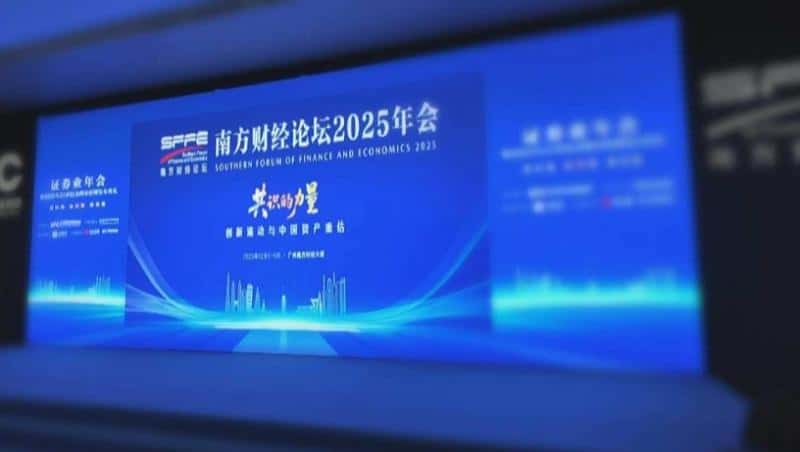
The Southern Forum of Finance and Economics 2025 convened in Guangzhou on December 5, bringing together experts to analyze China’s economic trajectory as it concludes the 14th Five-Year Plan and prepares for the next. The forum highlighted growing consensus around technological innovation, patient capital, and enhanced industry-finance collaboration as drivers of growth amid global uncertainties.
Key Focuses for the 15th Five-Year Plan
Tian Xuan, Dean of the National Institute of Financial Research at Tsinghua University, outlined three priorities for China’s upcoming economic blueprint. He emphasized that sustainable development relies on technological innovation to overcome institutional and technical barriers, requiring deep integration with industrial sectors to translate advancements into productive forces. Tian noted the financial system must expand direct financing through a multi-tiered capital market to better support innovation and the real economy. Additionally, he highlighted the need to balance growth with security, linking technological breakthroughs to industrial chain stability and green initiatives to energy and ecological concerns.
Finance and Technology Mutual Empowerment
Tian pointed out that while U.S. markets are dominated by tech firms, China’s top companies are largely in banking and traditional sectors, indicating room for improvement in financial support for the real economy. He described a two-way interaction where finance aids technological innovation, and thriving innovation, in turn, drives financial market development and product innovation.
Economic Vitality and Policy Shifts
Robin Xing, Chief China Economist at Morgan Stanley, summarized 2025’s economy with three “vitalizations”: flexible policies, dynamic enterprises, and active capital. He cited fiscal measures to boost consumption and social security as enhancing market confidence. Enterprises have shown resilience, particularly in tech self-reliance, while capital flows have increased, with global investors showing rising interest in China’s stable assets as U.S. uncertainties grow. Robin noted the 15th Five-Year Plan’s focus on science and technology, alongside goals to raise household consumption rates through social security and real estate stabilization, aiming to strengthen domestic demand and innovation ecosystems.
Accelerated Reforms and Atypical Recovery
Zhao Wei, Chief China Economist at Shenwan Hongyuan Securities, interpreted the plan’s guideline to “Consolidate Foundations and Accelerate All-Round Efforts.” He explained this involves solidifying industrial structures from the 14th Five-Year Plan and speeding up policy implementation in development and reform, including tasks from the Third Plenary Session. Zhao predicted an “atypical recovery” in 2026, driven by policy effects and reduced competition, leading to profit improvements via price recovery rather than volume growth, with structural differentiation across industries.
Industry, Technology, and People’s Livelihoods
Tao Chuan, Chief China Economist at Guolian Minsheng Securities, divided the plan into industry, technology, and people’s livelihoods. He noted China’s “AI +” Action Plan could leverage institutional advantages for vertical model development, while technological innovation must empower industries to create new growth engines. On consumption, Tao highlighted a shift from tangible asset investment to investing in people, focusing on social security, elderly care, childcare, and education to boost daily life quality.


